Journal Tables of Contents in the Catalog

I’ve written several times about TicTOCs (most recently in TicTOCs: It’s About Time). TicTOCs is a JISC-funded free service that collects RSS feeds for journal table of contents. If you go to the TicTOCs site you can search for journals (by title, ISSN, etc.), and find the RSS feed for that journal’s table of contents. They also offer a downloadable list of all the journals in their index, providing title, URL of the RSS feed, and ISSN. This should allow easy importing into a library catalog, federated search tool, or link resolver.
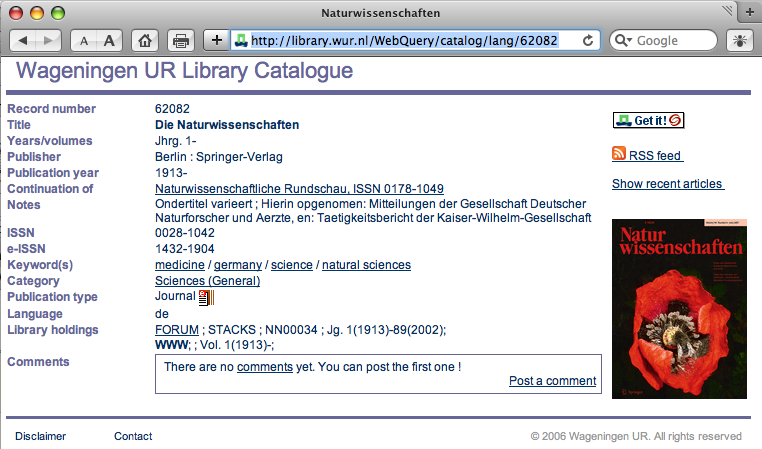
At least one library has implemented this feature. Peter van Boheemen, in his blogWebQuery @ Wageningen UR, describes how he added TicTOCs journal feeds to his catalog. A journal with a table of contents listed in TicTOCs has a link on the right side of the display to “Show recent articles” (this example is Die Naturwissenschaften from the Wageningen UR catalog):
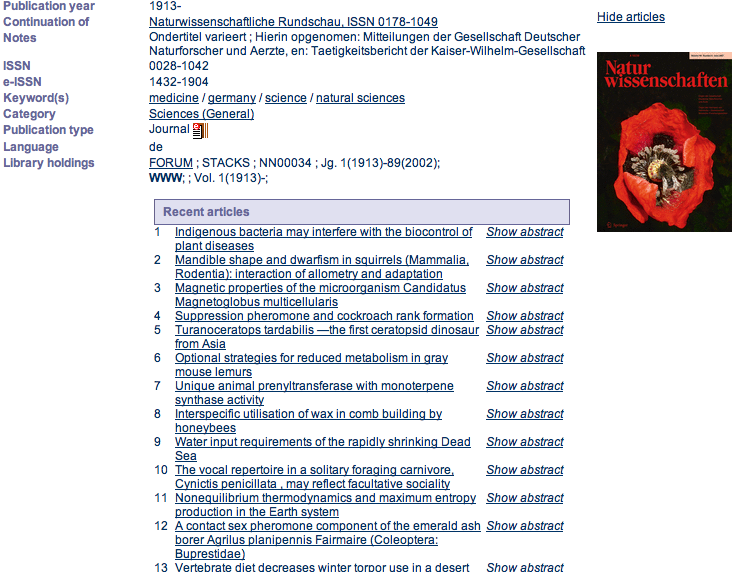
Clicking on that link displays the table of contents for the most recent issue of the journal in the lower part of the screen. Each article is linked to the full text (in this particular example, directly to SpringerLink, but it could just as easily go through a library’s proxy server or link resolver to find a copy licensed for that library):
Is your library using TicTOCs like this? Share your site in the comments.

Fair Use and Quoting Commercial Content

Say you’re blogging about a topic and you want to quote an excerpt of a commercial publication in your post. How much can you quote, verbatim, under the doctrine of “fair use“?
This is the subject of an article in Sunday’s New York Times: “Copyright Challenge for Sites That Excerpt.” Here’s how the Times article sums up the problem:

The legal disputes are emblematic of a larger question that has emerged from the Internet’s link economy. The editors of many Web sites, including ones operated by the Times Company, post excerpts from competitors’ content from time to time. At what point does excerpting from an article become illegal copying?

Courts have not provided much of an answer. In the United States, the copyright law provides a four-point definition of fair use, which takes into consideration the purpose (commercial vs. educational) and the substantiality of the excerpt.

[Yes, I’m aware of the irony of quoting an 88-word passage from an article about the dangers of quoting lengthy passages from commercial publications in a blog post.]

The concept of Fair Use is a tricky, and slippery one. The courts usually determine what is “fair” after the fact, when someone complains. A short excerpt that doesn’t reproduce the heart of the original almost certainly is fair use; a significant excerpt that reproduced the main point of the article probably is not. Reproducing the entire original clearly fails the text.

The culture of the blogosphere has been to define fair use quite broadly; the courts have rarely, if ever, had a voice in the matter. Yet. I suspect that, as the economic woes facing the corporate world drag on, commercial sites will increasingly perceive extensive quoting of their content on other sites as an economic problem. Whether such extensive quoting of published content has a real or imagined effect on revenue — and whether that effect is positive or negative — remains to be seen.

Related Posts